Spineless Prickly Pear
Spineless prickly pear is part of the opuntia, or prickly pear family. As such, it has familiar rounded cactus pads that grow into a large shrub.
What sets this cactus apart from other prickly pears, in contrast, are the lack of long spines that make it easier to handle, and ability to withstand cold temperatures down to 0 degrees Fahrenheit (zone 7).
Botanical name: Opuntia ellisiana
Other names: Opuntia cacanapa ellisiana, prickly pear ‘ellisiana’
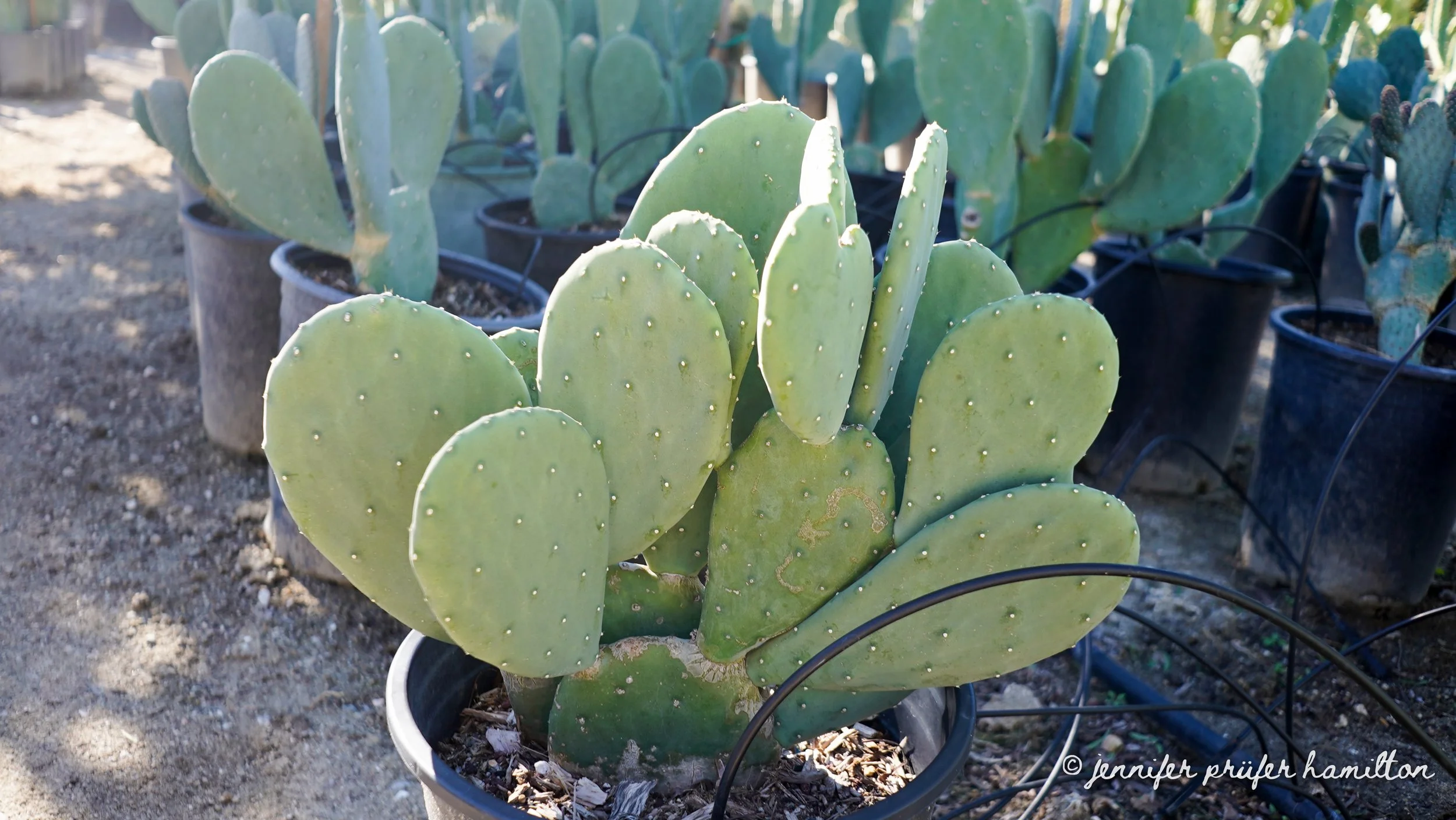
Spineless prickly pear for sale at the nursery
TABLE OF CONTENTS
Spineless Prickly Pear Appearance
Spineless prickly pear is a medium-sized cactus that can reach 5 feet tall and spread 7 feet wide.
The prickly pear is made up of mostly succulent and flat oval segmented cactus pads that grow on top of each other to create a large shrub. Some very mature plants have woody trunks.
Deep green cactus pads through which they photosynthesize.
As its nickname suggests, spineless prickly pear does not have long, sharp spines. However, it does have tiny hair-like spines called glochids, which grow from white circles across the cactus pads.
Large, beautiful, showy flowers when in bloom. The common colors are yellow and orange.
Followed by rounded red fruits.
Spineless Prickly Pear Landscaping Tips
Spineless prickly pear is edible. You can grill the cactus pads, also known as nopales, or juice the fruits, also known as tunas. The fruits tend to be sweet and tart. Both have glochids, which should be carefully scraped off.
Over time, grows into a very large clump. Keep in container for small spaces.
As with all prickly pears, spineless prickly pear is very easy to propagate. Detach a cactus pad and plant in soil to start a new plant.
One of the most cold hardy cacti. Can withstand temperatures down to 0 degrees Fahrenheit.
Protect young plants from the afternoon sun during summers in the Coachella Valley.
Spineless Prickly Pear Origin
Prickly pear is from the desert regions of the Americas. Spineless prickly pear is a mutated form from cultivation.
Spineless Prickly Pear Care
Soil: Loose, well-draining soil that is lightly fertile.
Temperature: Can withstand temperatures down to 0 degrees Fahrenheit.
Water: Occasional, deep watering. Allow the soil to dry out completely between waterings. Either use a moisture meter or stick your finger through the soil to gauge the moisture level. It’s better to err on the side of underwatering than overwatering.
Sun: Full sun or partial shade.
Spineless Prickly Pear Problems
Pests: Spineless prickly pear is susceptible to cochineal scale. To remove them, spray with a garden hose when the infestation is light. For more significant infestations, remove the most affected pads. Then, use insecticidal soap on the remaining pads.
Whenever using any pesticide, be aware that it can damage the plant if the temperatures are in the 80s or above.
Fungal diseases are caused by root rot, dry rot, and harsh weather conditions.
Signs of overwatering: Drooping, squishy texture (especially an the bottom of the cactus)
Signs of too little water: Shriveling, drying skin
Signs of too much sun: Burning, scarring
Signs of too little sun: Etiolation, discoloring
Spineless Prickly Pear Propagation
Remove cactus pads with caution since it has glochids. Allow the pads to dry for a few days, and then plant into well-draining soil.
FAQ
How much does Spineless Prickly Pear cost?
At our nursery, spineless prickly pear cactus costs $10 for a 1-gallon container, $35 for a 5-gallon container, $120 for a 15-gallon container, and $350 for a 24” box.
Prices are subject to change. Please get in touch with us for the most up-to-date pricing information. We may have larger sizes available. We provide installation services locally at a separate cost.
Is Spineless Prickly Pear edible?
Yes, the fruits and cactus pads of spineless prickly pear are edible.
Is Spineless Prickly Pear hardy?
Yes, it is one of the most cold hardy cacti. It can withstand temperatures down to 0 degrees Fahrenheit.
Summary
| SIZE (H X W) | 5ft X 7ft |
|---|---|
| FLOWER COLOR | Orange, Yellow |
| FLOWER SEASON | Spring |
| EXPOSURE | Full Sun |
| WATER | Low |
| GROWTH RATE | Moderate |
| HARDINESS | 0º F, USDA Zone 7 |
| PRUNING | None |