Spineless Yucca
Spineless yucca is a tough plant with high heat and drought tolerance to match its striking and towering appearance.
Unlike other yuccas, they have spineless leaves and tolerance for shade, so you can plant it in areas closer to foot traffic or those that only get partial shade.
Botanical name: Yucca gigantea
Other names: Giant yucca, Guatemalan yucca, Yucca elephantipes, Yucca guatemalensis
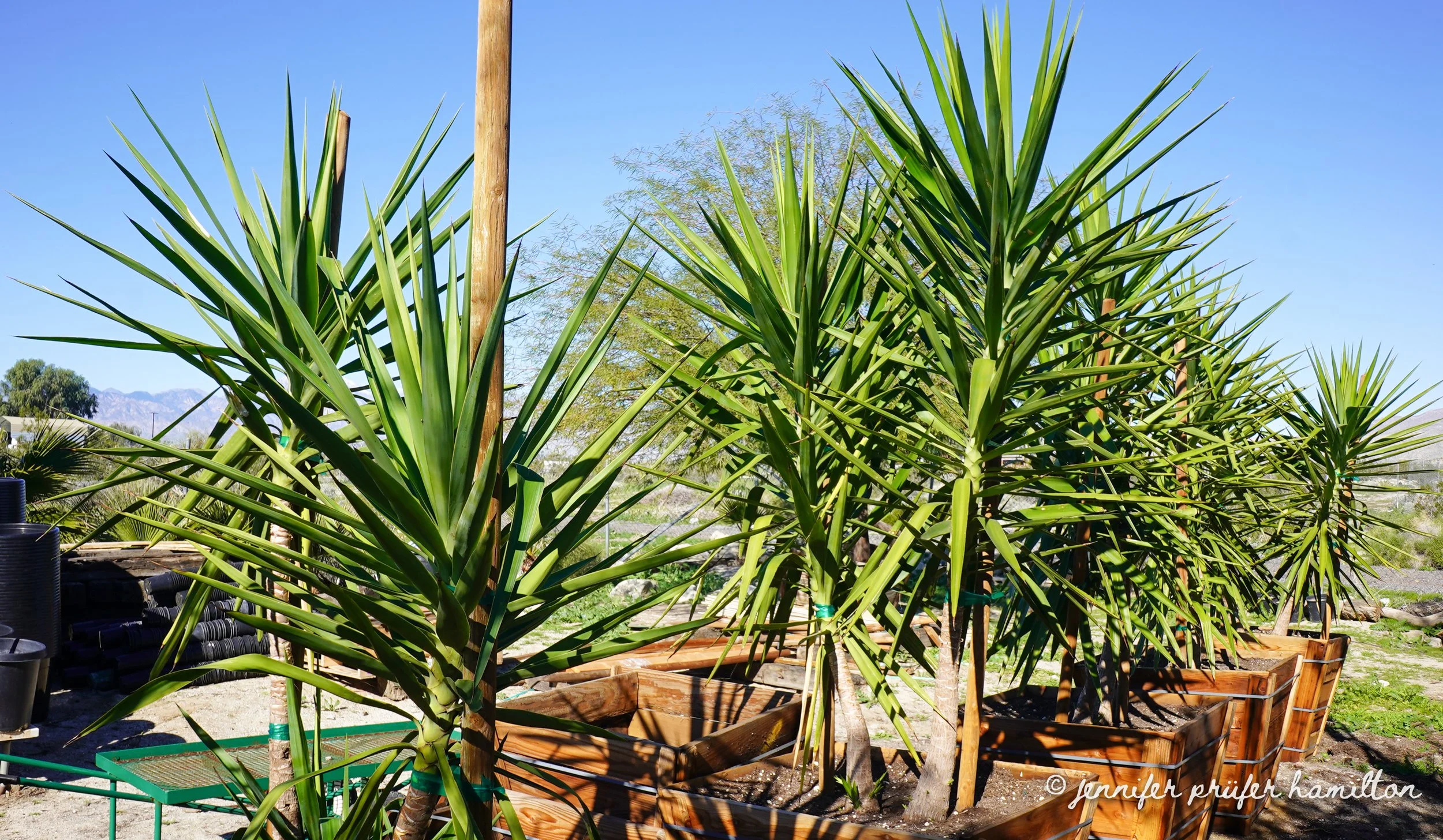
Spineless yucca for sale at nursery
TABLE OF CONTENTS
Spineless yucca Appearance
Spineless yucca has a very distinct appearance with its thick, upright trunk and cluster of long, stiff, deep green leaves that grow from the top.
The leaves do not have spiny edges, allowing for them to be enjoyed as a houseplant or outdoors near foot traffic.
Spineless yucca can become a large tree over 30 feet tall, although it commonly grows to 20-25 feet in the Palm Springs area. If planted in the ground, multiple trunks will form, creating a dense thicket. The base of the trunk will become the widest, earning its nickname "elephant yucca."
When in bloom, a 3-foot-tall flower stalk full of creamy white flowers will appear from the center of the plant, attracting moths for pollination.
Once pollinated, dark, 1-inch-long oval fruits will appear that contains seeds.
Spineless yucca Landscaping Tips
Provide ample space if grown outdoors. Not only does it grow to 25 feet tall, but it also grows a large trunk and root system that can damage sidewalks and foundations.
Can be grown indoors. Needs a lot of bright light and direct sunlight.
Very drought,, pest and heat resistant.
Minimal pruning is needed. Remove damaged or diseased leaves.
Beautiful white flowers are fragrant in the evening.
The flowers are edible. In fact, it is commonly eaten in Central American cuisine, particularly in El Salvador, where it is known as izote. Enjoy raw in salads or cooked in soups. Note that the leaves are toxic.
Spineless yucca Origin
Spineless yucca is from Mexico and Central America, in areas that experience warm and dry weather
Spineless yucca Care
Soil: Loose, well-draining soil that is moderately fertile.
Temperature: Can withstand temperatures down to frost (= 32 degrees) for a short period of time. Does very well in the heat.
Water: Occasional, deep watering. Allow the soil to completely dry out between waterings. Either use a moisture meter or stick your finger through the soil to gauge the moisture level. It’s better to err on the side of underwatering than overwatering.
Sun: Full sun. Partial shade is ok in the Palm Springs area. Direct sun and bright light if grown indoors.
Spineless yucca Problems
Pests: Spineless yucca has minimal pests. Fungal diseases from root rot, dry rot, and harsh weather conditions.
Pests may include mealybugs and aphids, especially when in bloom.
To remove mealybugs, use insecticidal soap or apply rubbing alcohol directly to the area of the infestation using a cotton swab.
For aphids, blast them off with water if the infestation is light. Otherwise, use horticultural oil or soapy water.
Whenever using any kind of pesticide, be aware that it can damage the plant if the temperatures are in the 80s or above.
Signs of overwatering: Squishy texture
Signs of too little water: Shriveling, drying
Signs of too much sun: Burning, scarring, fading color
Signs of too little sun: Etiolation (especially when grown indoors)
Spineless yucca Propagation
Propagate via seeds, stem cuttings, or offsets.
FAQ
How much does Spineless Yucca cost?
At our nursery, spineless yucca costs $45 for a 5-gallon container, $150 for a 15-gallon container, $350 for a 25-gallon container, and $650 for a 36” Box.
Prices are subject to change. Please contact us for the most up-to-date information on pricing. We may have larger sizes available. We provide installation services locally at a separate cost.
How big does a Spineless Yucca get?
Outdoors, spineless yucca cane can become a large tree, over 30 feet tall, although it commonly grows to 20 feet in the Palm Springs area. Indoors, it will typically reach the ceiling and often curve to make more room.
How do you propagate Spineless Yucca?
Spineless yucca is easy to propagate. The quickest way is to remove the offsets grown from the base of the trunk. You can also use a sharp blade to cut a stem right below a node. Allow it to callus first so that it doesn’t rot. You can also obtain seeds after the fruits have ripened, although this will be the slowest method.
Summary
| SIZE (H X W) | 25 feet x 15 feet |
|---|---|
| FLOWER COLOR | White |
| FLOWER SEASON | Spring, Summer |
| EXPOSURE | Full Sun to Partial Shade |
| WATER | Low |
| GROWTH RATE | Slow to Moderate |
| HARDINESS | 32º F, USDA Zone 9 |
| PRUNING | As Needed |