Gopher Spurge
Gopher spurge is a plant that got its nickname because many believe it repels critters like gophers and rabbits.
It’s a very low-maintenance plant that is tolerant to a wide range of temperatures, types of soil, and water availability.
It is pretty to look at as well, with its muted green leaves that contrast to its bright, neon yellow-green flowers.
Botanical name: Euphorbia rigida *Not to be confused with Euphorbia lathyris, another plant that shares the nickname “gopher spurge.”
Other names: Euphorbia biglandulosa, rigid euphorbia, rigid spurge, silver spurge, upright myrtle spurge
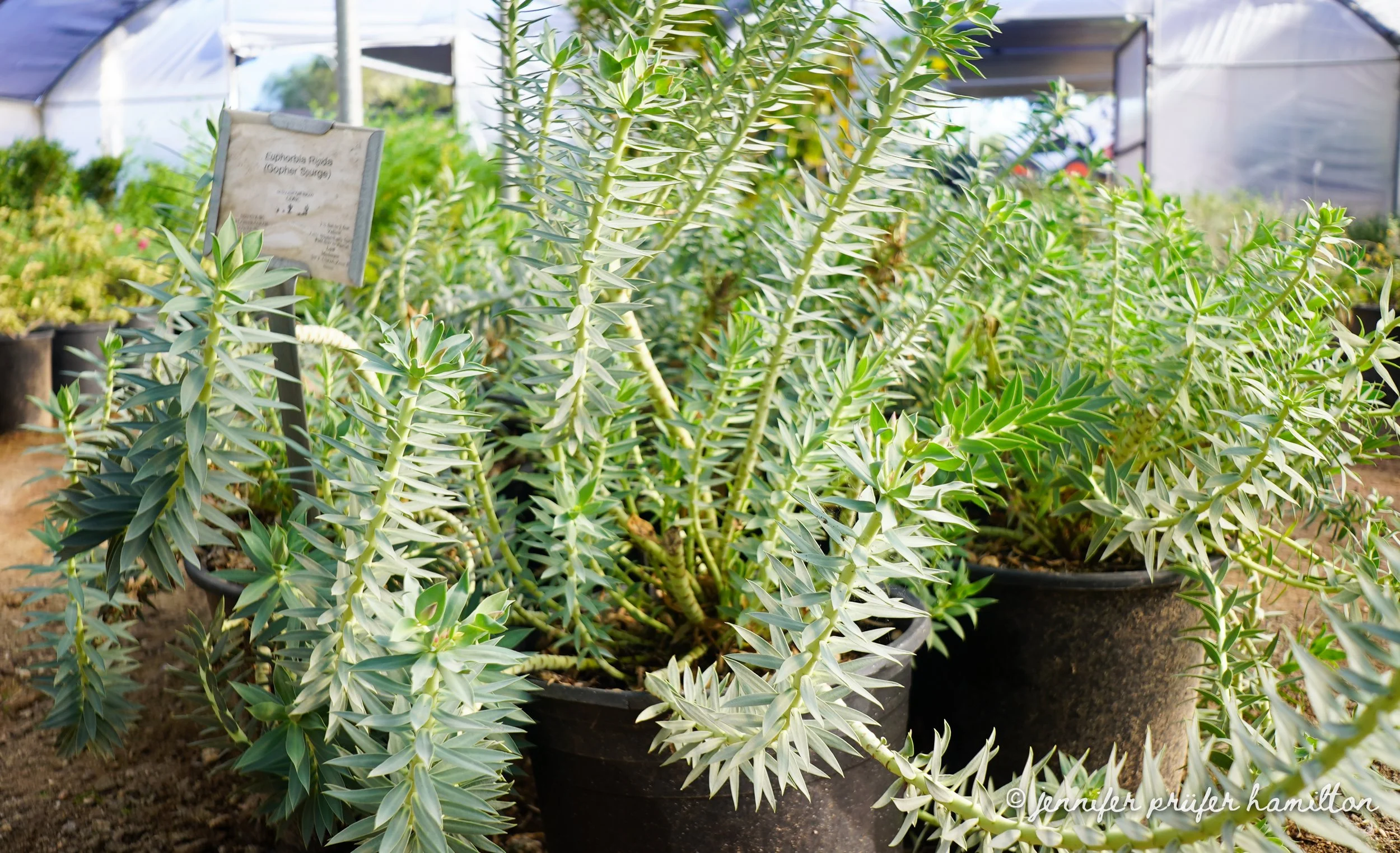
Gopher spurge for sale at the nursery
TABLE OF CONTENTS
Gopher Spurge Appearance
Euphorbia rigida, commonly known as gopher spurge, is a succulent plant with leaves that grow in an interesting spiral pattern and bright, showy flowers.
Mostly upright, shrubby growth habit. Rigida refers to the rigid stems. Grows to only 1-2 feet tall and 2-3 feet wide overall.
The individual leaves are silvery-green and 1-2 inches long. They turn to a red or brown color with cooler weather. In our region, gopher spurge is evergreen.
Star-shaped yellow flowers are showy and fluorescent. They become redder as they stay on the plant.
Followed by small, rounded green fruit pods.
Gopher Spurge Landscaping Tips
Due to its compact size, gopher spurge is a good candidate for garden borders and edges.
Plant among other drought-tolerant plants to add texture and visual interest. Great for rock gardens.
Tolerant of a wide range of soils. Can be planted in areas that have more clay or sand content.
Tolerant of a wide range of temperatures from 5 degrees Fahrenheit to triple-digit heat.
Mostly gopher-, deer-, and rabbit-resistant. Resistant to many insect pests.
White sap is toxic if ingested or touched. Keep away from children and pets. Handle with gloves.
Stems will die back after flowering. Prune these dead stems as needed. Perform heavy pruning in late fall to early winter.
Gopher Spurge Origin
Gopher spurge is from warm regions of Southern Europe and Northern Africa.
Gopher Spurge Care
Soil: Loose, well-draining soil that is lightly fertile. Adaptable to a wide range of soils.
Temperature: Can withstand temperatures down to 5 degrees Fahrenheit for a short period of time.
Water: Occasional, deep watering. Allow the soil to dry out between waterings. Either use a moisture meter or stick your finger through the soil to gauge the moisture level.
Sun: Full sun. Partial shade in Palm Springs region is ok.
Gopher Spurge Problems
Pests: Gopher spurge has minimal pests.
Fungal diseases include root rot, dry rot, and harsh weather conditions.
Signs of overwatering: Drooping, squishy texture, root rot
Signs of too little water: Shriveling, drying, dropping leaves and flowers
Signs of too much sun: Burning, fading color
Signs of too little sun: Etiolation, discoloring, few blooms
Gopher Spurge Propagation
Collect the seeds once the fruits have ripened and plant in moist soil.
FAQ
How much does Gopher Spurge cost?
At our nursery, gopher spurge costs $20 for a 5-gallon container.
Prices are subject to change. Please contact us for the most up-to-date information on pricing. We may have larger sizes available. We provide installation services locally at a separate cost.
Is gopher spurge poisonous?
Yes, it has white sap that is toxic if ingested or touched. Keep from children and pets.
Why is my gopher spurge not flowering?
The most common reason for it not flowering is due to not enough sunlight.
SUMMARY
| SIZE (H X W) | 2 feet x 3 feet |
|---|---|
| FLOWER COLOR | Yellow |
| FLOWER SEASON | Year Round |
| EXPOSURE | Full Sun, Partial Shade |
| WATER | Low |
| GROWTH RATE | Moderate |
| HARDINESS | 5º F, USDA Zone 7 |
| PRUNING | As Needed |