Flame Vine
Flame vine is a favorite of our resident hummingbirds as can be seen in the image below.
It adds a cheery pop of orange during the cooler months, but the dense leaves also have a nice deep green hue that gives a tropical feel to the landscape year round.
Botanical name: Pyrostegia venusta
Other names: Flame flower vine, Pyrostegia ignea
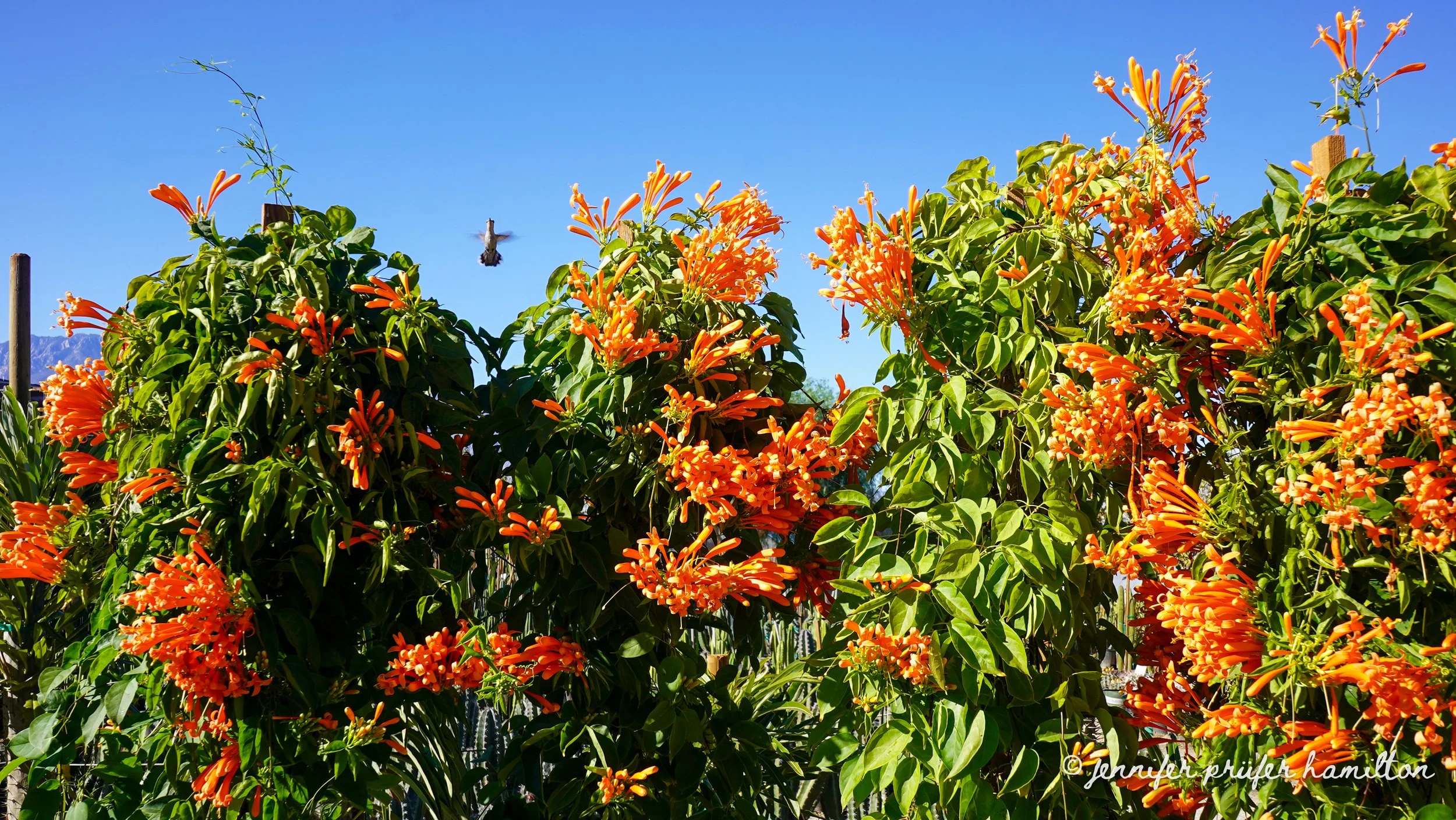
Flame vine for sale at the nursery
TABLE OF CONTENTS
Flame Vine Appearance
Flame vine is a vigorous flowering vine that grows to over 70 feet tall.
Deep green evergreen leaves. Woody stems and small tendrils help it to latch onto support such as trees and trellises.
Main blooming season is from fall to spring. Small, very bright orange tubular flowers bloom in clusters on flower stalks.
Followed by seed pods that contain seeds that spread via wind.
Flame Vine Landscaping Tips
Grows and establishes itself quickly. Use to add color and shade to a pergola or a fence.
Will smother and weaken trees if allowed to climb on them.
Bright and showy flowers provide a pop of color during the cooler seasons. A favorite of hummingbirds when in bloom.
Moderately drought tolerant once mature. Do not allow the roots to completely dry out when still establishing the plant.
Prune dead or weakened stems to keep the plant tidy and healthy throughout the year. Do not cut more than a third of the entire plant at once.
Flame Vine Origin
Flame vine is from warm regions of Brazil and Paraguay
Flame Vine Care
Soil: Fast draining soil is important. Can tolerate different soil types, but loamy is best.
Temperature: Prefers warm weather. Can withstand temperatures down to 28 degrees for a brief period of time.
Water: Requires moderate water. More drought tolerant once mature.
Sun: Full sun to partial shade.
Flame Vine Problems
Pests: Flame vine attracts minimal pests, which are usually aphids and spider mites.
For aphids, blast them off with water if the infestation is light. Otherwise, use horticultural oil or soapy water.
For spider mites, control the infestation as soon as it’s discovered. Some options are horticultural oil applied several days apart as well as insecticidal soap combined with hydrogen peroxide. Use commercial pesticide for severe infestations.
Whenever using any kind of pesticide, be aware that it can damage the plant if the temperatures are in the 80s or above.
Signs of overwatering: Fewer flowers, root rot
Signs of too little water: Wilting, dropping leaves
Signs of too much sun: Fading color
Signs of too little sun: Etiolation, dulling color of bracts
Flame Vine Propagation
Take 1 foot cuttings from the tip and plant in soil. Otherwise, obtain seeds from seed pods.
FAQ
How much does Flame Vine cost?
At our nursery, flame vine costs $25 for a 5-gallon container, $50 for a 15-gallon container, and $200 for a 25-gallon.
Prices are subject to change. Please contact us for the most up-to-date information on pricing. We may have larger sizes available. We provide installation services locally at a separate cost.
Is Flame Vine Invasive?
Flame vine is considered invasive in some regions such as Florida and Hawaii. It is not considered invasive in our desert region.
Is Flame Vine drought tolerant?
Flame vine is somewhat drought tolerant once mature. Do not allow the roots to completely dry out when still establishing the plant.
Summary
| SIZE (H X W) | 70 feet |
|---|---|
| FLOWER COLOR | Orange |
| FLOWER SEASON | Fall to Spring |
| EXPOSURE | Full Sun to Partial Shade |
| WATER | Moderate |
| GROWTH RATE | Moderate |
| HARDINESS | 28º F, USDA Zone 9 |
| PRUNING | As Needed |