Arabian Jasmine
Arabian jasmine is a wonderfully fragrant plant that has been popular in South Asia for centuries. It is often used for ceremonial and wellness purposes due to its beloved flower.
Even though it hails from a tropical region, those that dwell in the desert will be happy to know that they can enjoy its fragrance too as long as the jasmine gets ample shade and moderate water.
Botanical name: Jasminum sambac
Other names: Indian jasmine, sampaguita, sambac, zambac
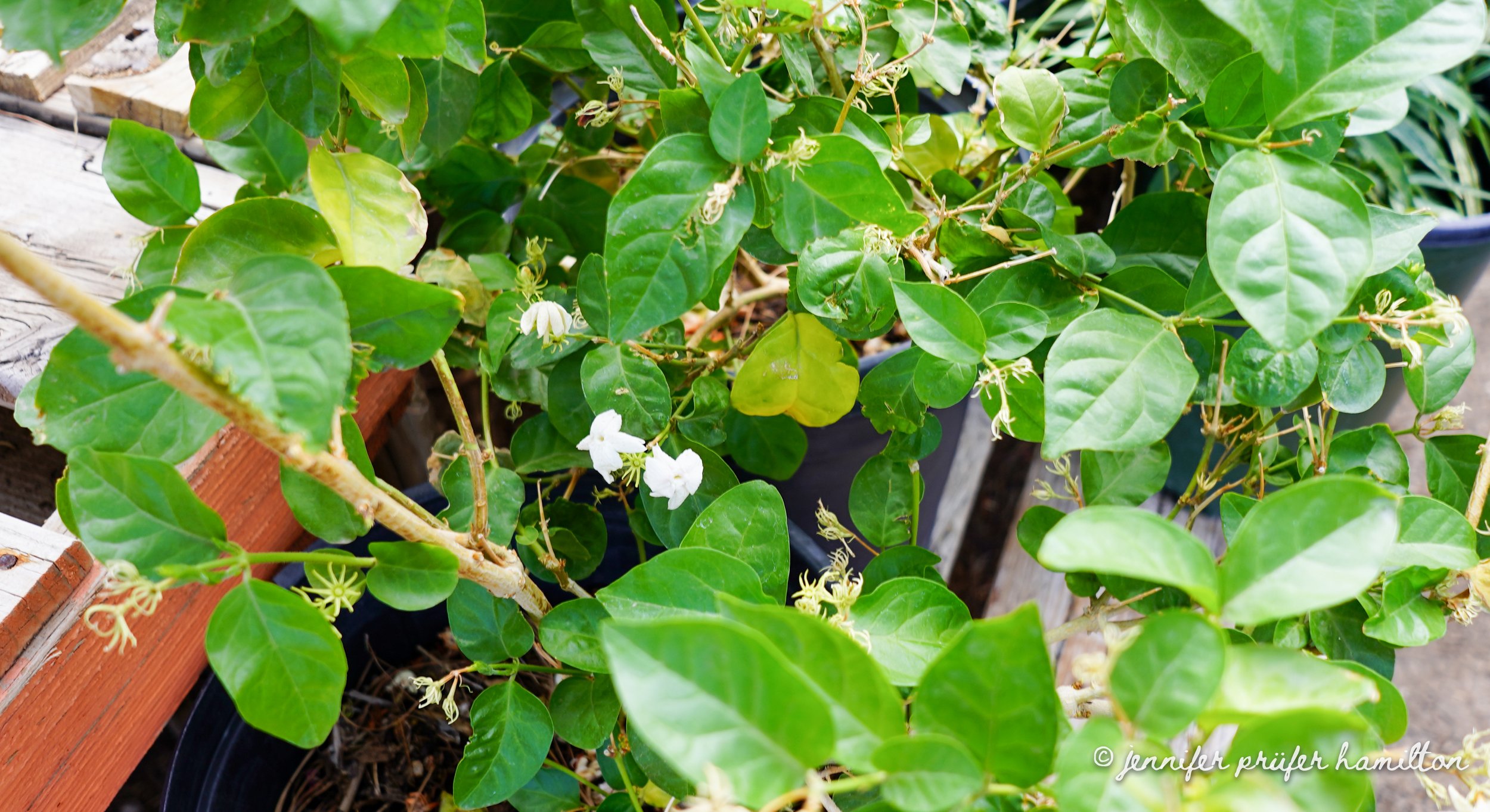
Arabian jasmine for sale at the nursery
TABLE OF CONTENTS
Arabian Jasmine Appearance
Arabian jasmine is a woody flowering plant that typically reaches 3 feet tall as a shrub or 8 feet as a climbing vine.
The leaves are glossy and medium green. They have prominent veins and are round with tapered ends. They grow in opposite pairs on branches. Evergreen in regions with mild winters.
Small white flowers that are about an inch long with flat, rounded petals when in bloom. Very strong, sweet perfume.
Followed by a fruit containing seeds.
Arabian Jasmine Landscaping Tips
Extremely fragrant. Good candidate for patios and near the house.
In Palm Springs region, keep it partially shaded. Early morning sun and shade for the rest of the day work best.
Takes to pruning well. Shape into a vine and support and tie the stems for climbing. In hot deserts, note the temperature of the supporting surface. If it’s too hot, it may burn the leaves and flowers.
Keep the pruning to a minimal to keep it as a medium-sized shrub.
Performs well in containers. Can be brought indoors during hot or cold temperatures.
Will attract pollinators such as bees, butterflies, and moths when in bloom.
Alongside the common jasmine (Jasminum officinale), Arabian Jasmine (Jasminum sambac) is often used for making jasmine tea or jasmine oil for perfumes.
Arabian Jasmine Origin
Arabian jasmine is from tropical regions of southeastern Asia such as Bhutan and India
Arabian Jasmine Care
Soil: Loose, well-draining soil. Use a fertilizer formulated for blooms during the growing season.
Temperature: Can withstand temperatures down to frost (= 32 degrees) for a short period of time.
Water: Regular watering during the growing season. Allow the soil to slightly dry out between waterings. Either use a moisture meter or stick your finger through the soil to gauge the moisture level.
Sun: Partial shade. In Palm Springs region, mild morning sun and afternoon shade is best.
Arabian Jasmine Problems
Pests: Common pests found on jasmines are mealybugs and spider mites.
To remove mealybugs, use insecticidal soap or apply rubbing alcohol directly to the area of infestation using a cotton swab.
To remove spider mites, use horticultural oil for crawlers and insecticidal soap for mites of all stages.
Whenever using any kind of pesticide, be aware that it can damage the plant if the temperatures are in the 80s or above.
Signs of overwatering: Rotting roots and stems, soil that does not dry out
Signs of too little water: Shriveled appearance
Signs of too much sun: Burning, fading leaves
Signs of too little sun: Etiolation, stunted growth
Arabian Jasmine Propagation
Propagate jasmine via cuttings. The best time to make a cut is in early spring before the growing season begins.
Remove a branch using a sterile, sharp blade. For best results, use a rooting hormone. Plant in moist soil.
FAQ
How much does Arabian Jasmine cost?
At our nursery, Arabian jasmine costs $20 - $25 for a 5-gallon container and $50 for a 15-gallon container.
Prices are subject to change. Please contact us for the most up-to-date information on pricing. We may have larger sizes available. We provide installation services locally at a separate cost.
Is arabian jasmine a bush or vine?
Arabian jasmine is a flowering bush that can easily be trained into a climbing vine.
Why is my Arabian jasmine not blooming?
The most likely reasons are that it is either not getting enough sunlight or nutrition. Move it to a place where it can get more sun and/or provide fertilizer formulated for blooms (high P content in N-P-K fertilizer ratio). Please note that Arabian jasmine does not need a lot of sunlight if grown outdoors in hot and dry regions.
Summary
| SIZE (H X W) | 8 feet tall X 3 feet wide |
|---|---|
| FLOWER COLOR | White |
| FLOWER SEASON | Year Round |
| EXPOSURE | Partial Shade |
| WATER | Medium |
| GROWTH RATE | Moderate |
| HARDINESS | 32º F, USDA Zone 9 |
| PRUNING | As Needed |