Agave Sisalana
Agave sisalana is a historically important plant that is now planted across the world for its famous sisal fiber. The tough fibers are used for making a variety of products like rope, carpet, and construction tools.
In the landscape, the long and stiff leaves of the agave have a strong appearance to match the toughness of its fiber. The geometric rosette shape and deep green color add elegance and stateliness as well.
Botanical name: Agave sisalana
Other names: Sisal, sisal agave
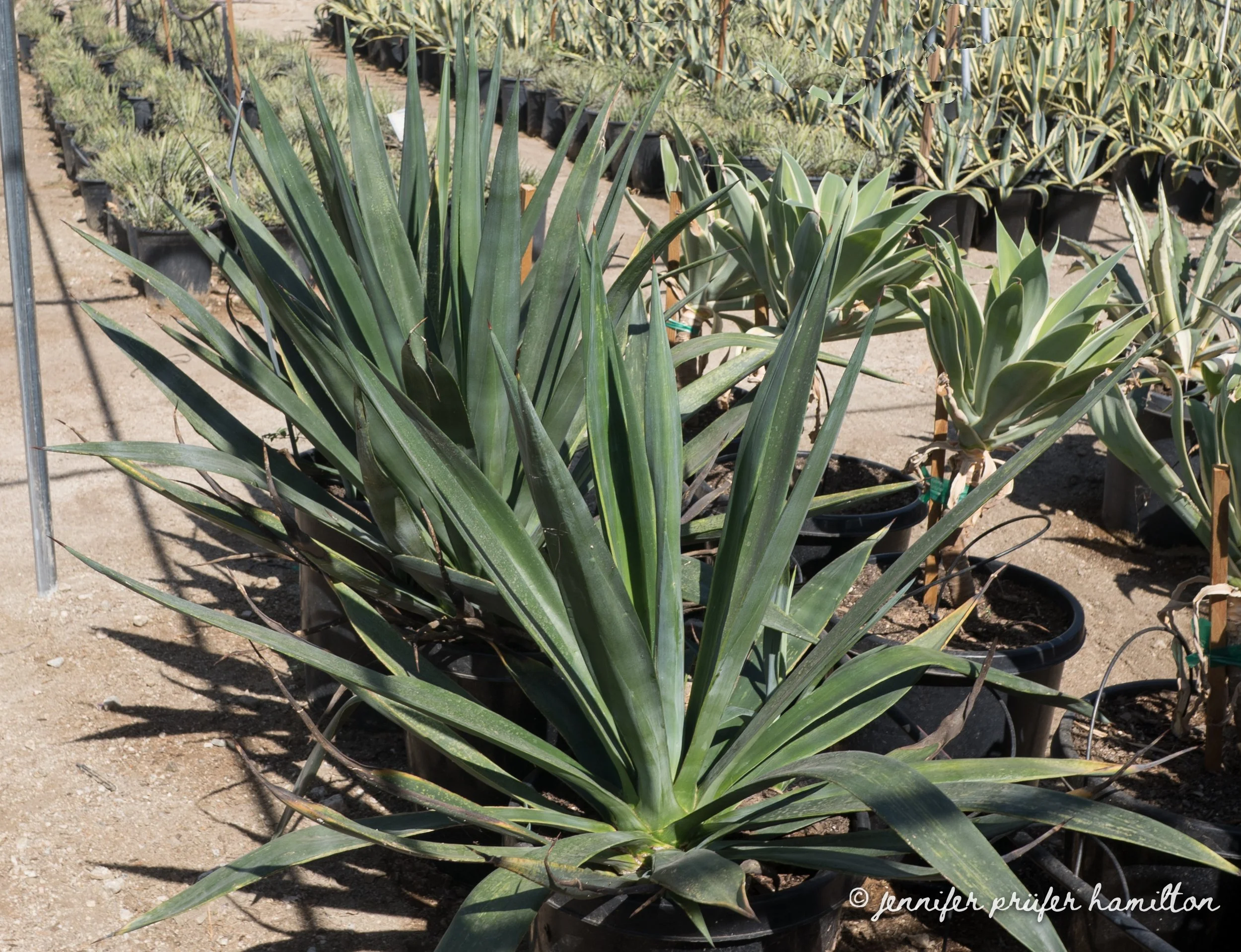
Agave sisalana for sale at our nursery
TABLE OF CONTENTS
Agave Sisalana Appearance
Deep green leaves that are 7 feet long form a rosette shape. The leaves are long and narrow and have long and sharp tips at the ends.
Yellow flowers bloom from a 15+ feet long flower stalk that appears at the end of the agave's life. The flowers are numerous and stay for a very long time on the stalk, attracting many pollinators.
Yellow-green fruits turn dark as they ripen, containing small black seeds.
Agave Sisalana Landscaping Tips
The deep green leaves and their geometric pattern make this agave an elegant plant. Plant alongside other desert plants, such as artichoke agave or golden barrel cactus to add texture and color to the landscape.
Some prefer to prune the lower leaves to expose the lower trunk for a more formal look.
Agave sisalana was historically used by native American populations to produce sisal, which is a type of fiber used to create rope, twine, baskets, mats, carpet, and other household items. Today, it is an important source of fiber globally and is cultivated in warm regions across different continents.
Has a short lifespan of about 10 years, but produces offsets throughout its life.
Attracts many bees during its extended bloom period.
Agave Sisalana Origin
Agave sisalana is native to warm areas in southern Mexico and Central America
Agave Sisalana Care
Soil: Loose, well-draining soil.
Temperature: Can withstand temperatures down to 25 degrees for a short period of time.
Water: Occasional, deep watering. Allow the soil to completely dry out between waterings. Either use a moisture meter or stick your finger through the soil to gauge the moisture level. It’s better to err on the side of underwatering than overwatering.
Sun: Full sun to partial shade
Agave Sisalana Problems
Pests: Agave sisalana has minimal pests. Fungal diseases from root rot, dry rot, and harsh weather conditions.
Signs of overwatering: Drooping, squishy texture (especially at the bottom of the agave)
Signs of too little water: Shriveling, drying skin
Signs of too much sun: Burning, scarring, fading color
Signs of too little sun: Etiolation, discoloring
Agave Sisalana Propagation
Agave sisalana produces offsets throughout its lifetime. Remove the offsets to propagate.
FAQ
How much does Agave Sisalana cost?
At our nursery, agave sisalana costs $10 for a 1-gallon container, $35 for a 5-gallon container, $85 for a 15-gallon container, and $175 for a 24" box.
Prices are subject to change. Please contact us for the most up-to-date information on pricing. We may have larger sizes available. We provide installation services locally at a separate cost.
Is agave sisalana cold hardy?
Agave sisalana can tolerate frost, but it is best to grow it in regions where the temperatures do not get lower than 25º F.
Does agave Sisalana have prickly spines?
Yes, agave sisalana has long and pointy spines at the end of the leaves. If planting near foot traffic, you may want to cut the pointy spines to make it more dull.
Summary
| SIZE (H X W) | 7 feet X 7 feet |
|---|---|
| FLOWER COLOR | Yellow |
| FLOWER SEASON | Spring |
| EXPOSURE | Full Sun |
| WATER | Low |
| GROWTH RATE | Moderate |
| HARDINESS | 25º F, USDA Zone 8 |
| PRUNING | None |